Tandem ICP-mass spectrometry (ICP-MS/MS)
Inductively coupled plasma-mass spectrometry (ICP-MS) is one of the leading techniques in the field of elemental analysis, focusing on the determination of ultra-trace levels of metals and metalloids in a large variety of sample types. However, next to a long list of advantages (e.g., high detection power, a pronounced multi-element character, a wide linear dynamic range and the possibility to obtain isotopic information), the technique is also characterized by some drawbacks, the occurrence of spectral interferences being the most important one.
In the last 15 years, several companies have developed quadrupole-based ICP-MS instruments equipped with a quadrupole-, hexapole- or octopole-containing collision-reaction cell that can be pressurized with a gas. Depending on the type of instrument, interferences can be removed by either (i) selective reaction of the analyte and/or interfering ion(s) with a reactive gas or (ii) collisions of the ions with a non-reactive gas, in combination with kinetic energy discrimination.
Recently, the gamut of quadrupole-based ICP-MS instruments has been further extended with a new type of instrument, i.e., an ICP-tandem mass spectrometer (MS/MS), often also referred to as triple quadrupole ICP-MS (or ICP-QQQ). This type of instrument is characterized by the presence of an additional quadrupole analyzer in front of the collision-reaction cell. This quadrupole filter (Q1) can be operated as a mass filter, thereby only allowing ions with one m/z-ratio to enter the cell. This leads to a much better control over the reactions taking place in the cell and more insight into the reaction mechanisms and the origin of the reaction product ions observed.
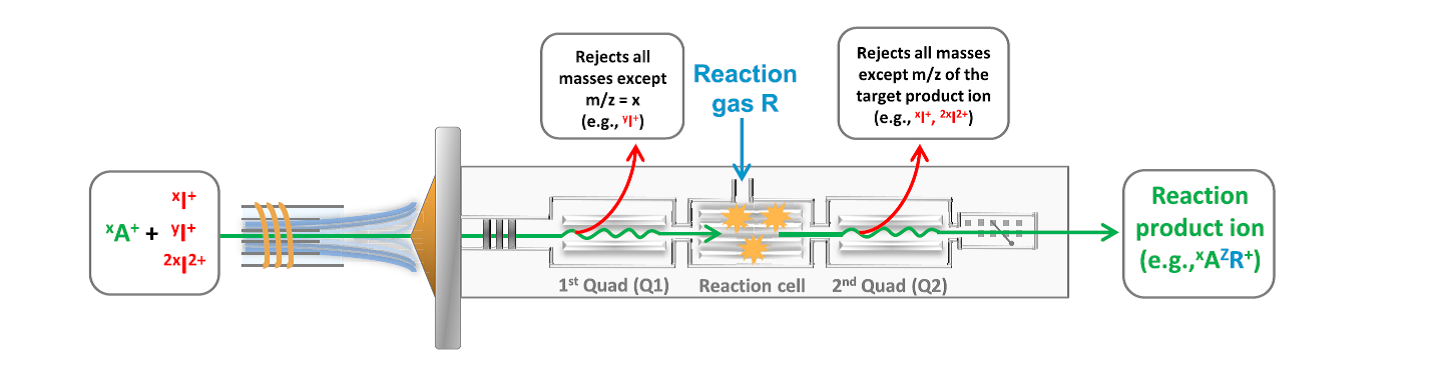
Schematic representation of the operating principle of the tandem mass spectrometer system, functioning in MS/MS mode, leading to an interference-free determination of xA+ (at the mass of a reaction product ion). A stands for analyte element, I for interference.
The activities of the A&MS research group in this context are illustrated below via a couple of case studies published in the international literature. For more applications, you are invited to check our list of publications.
Accurate determination of ultra-trace levels of Ti in blood serum using ICP-MS/MS
Ti is frequently used in implants and prostheses and it has been shown before that the presence of these in the human body can lead to elevated Ti concentrations in body fluids such as serum and urine. As identification of the exact mechanisms responsible for this increase in Ti concentrations, and the risks associated with it, are not fully understood, it is important to have sound analytical methods that enable straightforward quantification of Ti levels in body fluids (for both implanted and non-implanted individuals). This work reports on the development of a novel method for the accurate and precise determination of trace levels of Ti in human serum samples, based on the use of ICP-MS/MS. O2 and NH3/He have been compared as reaction gases. While the use of O2 did not enable to overcome all spectral interferences, it has been shown that conversion of Ti+ ions into Ti(NH3)6+ cluster ions by using NH3/He as a reaction gas in an ICP-QQQ system, operated in MS/MS mode, provided interference-free conditions and sufficiently low limits of detection, down to 3 ng L−1 (instrumental detection limit obtained for the most abundant Ti isotope). The accuracy of the method proposed was evaluated by analysis of a Seronorm Trace Elements Serum L-1 reference material and by comparing the results obtained with those achieved by means of SF-ICP-MS. As a proof-of-concept, the newly developed method was successfully applied to the determination of Ti in serum samples obtained from individuals with and without Ti-based implants. The typical basal Ti level in human serum was found to be <1 µg L−1, while values in the range of 2–6 µg L−1 were observed for implanted patients.

Product ion scans (Q1: 48 – Q2: scanned) for a solution containing 1 µg L−1 Ti (grey – line pattern) and a solution containing 1 µg L−1 Ti + 10 mg L−1 Ca (black – solid fill), with NH3/He as reaction gas.
More information: Balcaen et al., Analytica Chimica Acta, 2014, 809, 1-8.
Potential of methyl fluoride as a universal reaction gas to overcome spectral interference in the determination of ultra-trace concentrations of metals in biofluids using inductively coupled plasma-tandem mass spectrometry
Methyl fluoride (a mixture of 10% CH3F and 90% of He) was evaluated as a reaction gas in inductively coupled plasma-tandem mass spectrometry (ICP-MS/MS) in the context of the determination of ultra-trace concentrations of medically relevant metals (Al, Co, Cr, Mn, Ni, Ti, and V) in blood serum and urine. Via product ion scanning, whereby only ions of the mass-to-charge ratio of the target nuclide were admitted into the octopole reaction cell, the various reaction product ions formed for each of the target elements were identified at different CH3F gas flow rates. Limits of detection (LODs) and of quantification (LOQs) and linearity of the calibration curve were documented under (i) optimized ICP-MS/MS conditions for single-element monitoring and (ii) compromise conditions, allowing for multi-element determination. Even under compromise settings, instrumental LODs were below 10 ng/L for all target elements, while the use of CH3F provided interference-free conditions for their determination in the biofluids of interest.
More information: Bolea-Fernandez et al., Analytical Chemistry, 2014, 86, 7969-7977.
Laser ablation-tandem ICP-mass spectrometry (LA-ICP-MS/MS) for direct Sr isotopic analysis of solid samples with high Rb/Sr ratios
The combination of laser ablation and tandem ICP-mass spectrometry (LA-ICP-MS/MS) allows for Sr isotopic analysis of solid samples with high Rb/Sr ratios. Isobaric overlap at a mass-to-charge ratio of 87 (87Sr–87Rb) is overcome via chemical resolution. By using CH3F/He (10% CH3F in He) in an octopole collision-reaction cell, Sr+ ions are converted into the corresponding SrF+ reaction product ions, while Rb+ ions show no reactivity towards this gas mixture. The 87Sr/86Sr isotope ratio results were corrected for instrumental mass discrimination using a double correction approach – internal correction using the Russell law, followed by external correction in a sample–standard bracketing (SSB) approach. NIST SRM 610 was applied as an external standard for mass bias correction; no closer matrix-matching was required for the sample types investigated. Under “wet” plasma conditions, accurate and precise (0.02–0.05% RSD) 87Sr/86Sr isotope ratio results were obtained for glass-type geological reference materials.

Influence of the Rb/Sr ratio on the raw 87Sr/86Sr (left y-axis) and 88Sr/86Sr (right y-axis) isotope ratios for “vented” (orange) and CH3F/He (blue) modes. When the cell is pressurized with CH3F/He, the SrF+ ion signals are measured and the influence of the isobaric interference of 87Rb and 87Sr is avoided.
More information: Bolea-Fernandez et al., Journal of Analytical Atomic Spectrometry, 2016, 31, 464-472.
Characterization of SiO2 nanoparticles by single particle-inductively coupled plasma-tandem mass spectrometry (SP-ICP-MS/MS)
The increase in the use of SiO2 nanoparticles (NPs) is raising concern about their environmental and health effects, thus necessitating the development of novel methods for their straightforward detection and characterization. Single particle ICP-mass spectrometry (SP-ICP-MS) is able to provide information on the size of NPs, their particle number density and mass concentration. However, the determination of Si via ICP-MS is strongly hampered by the occurrence of spectral overlap from polyatomic species (e.g., CO+ and N2+). The use of tandem ICP-MS (ICP-MS/MS) enables interference-free conditions to be obtained, even in the most demanding applications. Upon testing several gases, the use of CH3F (monitoring of SiF+, mass-shift approach) and of H2 (monitoring of Si+, on-mass approach) were demonstrated to be the most suitable to overcome the spectral interference affecting ultra-trace Si determination (LoD < 15 ng L-1). By using these approaches, SiO2 NPs (ranging between 80 and 400 nm) can be detected and characterized. For SiO2 NPs > 100 nm, it was possible to provide accurate results in a straightforward way, as the signals they give rise to are well resolved from those of the background. In the case of 80 and 100 nm NPs, the use of a simple deconvolution approach following a Gaussian model was needed to characterize SiO2 NPs apparently showing incomplete distributions as a result of the presence of the background signal. Overall, the methods developed using SP-ICP-MS/MS are sensitive and selective enough for the interference-free determination of Si at ultra-trace levels, also in the form of SiO2 NPs.
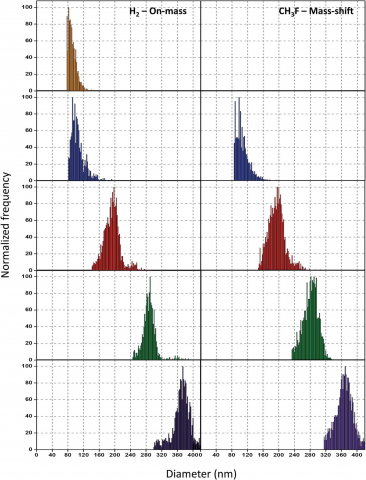
Particle size distributions calculated for SiO2 NP suspensions of different sizes ranging from 80 to 400 nm using H2 (on-mass) and CH3F (mass-shift) approaches in ICP-MS/MS, with concentrations of the SiO2 NP suspensions ranging between 0.1–5 and 0.5–5 mg L-1 for H2 and CH3F, respectively. Normalized frequency refers to the number of NPs detected for each size normalized to the number of NPs counted at the peak maximum.
More information: Bolea-Fernandez et al., Journal of Analytical Atomic Spectrometry, 2017, 32, 2140-2152.