Isotopic analysis
The A&MS research group is a partner of the UGent – Stable Isotope Facility (UGent-SIF) expertise centre.
The A&MS group is offering service measurements and scientific cooperation in the context of high-precision multi-collector ICP-MS isotopic analysis. For more information please contact: Lieve.Balcaen@UGent.be
The A&MS group is specialized in the development of analytical strategies for the isotopic analysis of elements showing natural variation in their isotopic composition as a result of (i) the presence of one or more radiogenic isotope(s) – e.g., Sr, Nd, Pb – or (ii) isotope fractionation accompanying physical processes and/or (bio)chemical reactions. In this context, multi-collector ICP – mass spectrometry is used as a dedicated tool for high-precision isotopic analysis of metals and metalloids. The simultaneous monitoring of the intensity of the various ion beams involved provides a superior isotope ratio precision, down to 0.001% RSD (internal precision) under ideal circumstances, allowing small differences to be resolved and quantified.
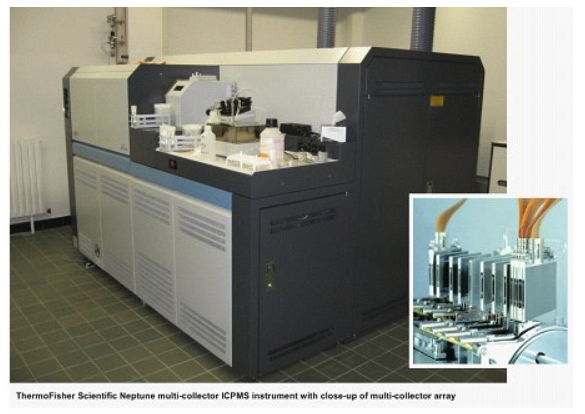
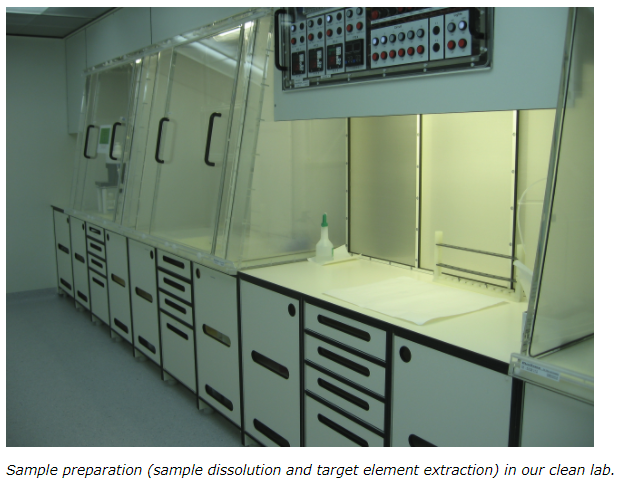
For also assuring accuracy of the isotope ratio data, the target element needs to be isolated out of the matrix with quantitative recovery. For avoiding contamination from affecting the original isotopic signature, this sample pretreatment is typically carried out in a class-10 clean lab.
The activities of the A&MS research group in this context are illustrated below via a couple of case studies published in the international literature in the fields of:
· Biomedical applications
· Environmental applications
· Geo- and cosmochemical applications
· Provenance determination
For more applications, you are invited to check our list of publications.
Biomedical applications
Isotopic analysis of Cu in human serum of liver disease patients and for follow-up of liver transplant samples
The isotopic composition of blood serum Cu has been investigated as a potential parameter for the diagnosis and prognosis of liver cirrhosis. Cirrhosis occurs due to long-term damage and is characterized by the replacement of normal liver tissue by scar tissue and nodules, as a result of which the liver gradually loses its structure and function. Typically, the disease develops slowly over months or years and early on, there are often no symptoms. Serum samples from supposedly healthy women (reference population) and from a group of female patients suffering from liver cirrhosis of different etiologies were analyzed. Significant differences in the isotopic composition of Cu were observed between the reference population and the patients. A wide spread in δ65Cu was observed within the cirrhosis population and the δ65Cu value seems to become lighter with the severity of the disease.
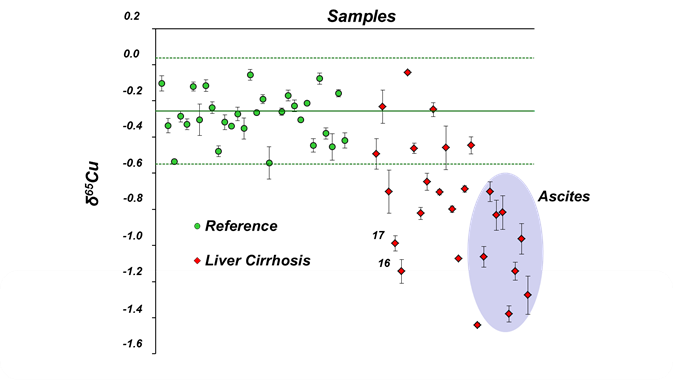
More information: Costas Rodriguez et al., Metallomics, 2015, 7, 491-498.
End-stage liver disease (ESLD) is life-threatening and liver transplantation (LTx) is the definitive treatment with good outcomes. Given the essential role of hepatocytes in Cu homeostasis, the potential of the serum Cu isotopic composition for monitoring a patient’s condition post-LTx was evaluated. Before the liver transplantation, the Cu isotopic composition of the ESLD patients was fractionated in favor of the lighter isotope (by about −0.50‰). Post-LTx, a generalized normalization of the Cu isotopic composition was observed for the patients with normal liver function, while it remained light when this condition was not reached. A strong decrease in the δ65Cu value a longer term post-LTx seems to indicate the recurrence of liver failure or cancer.
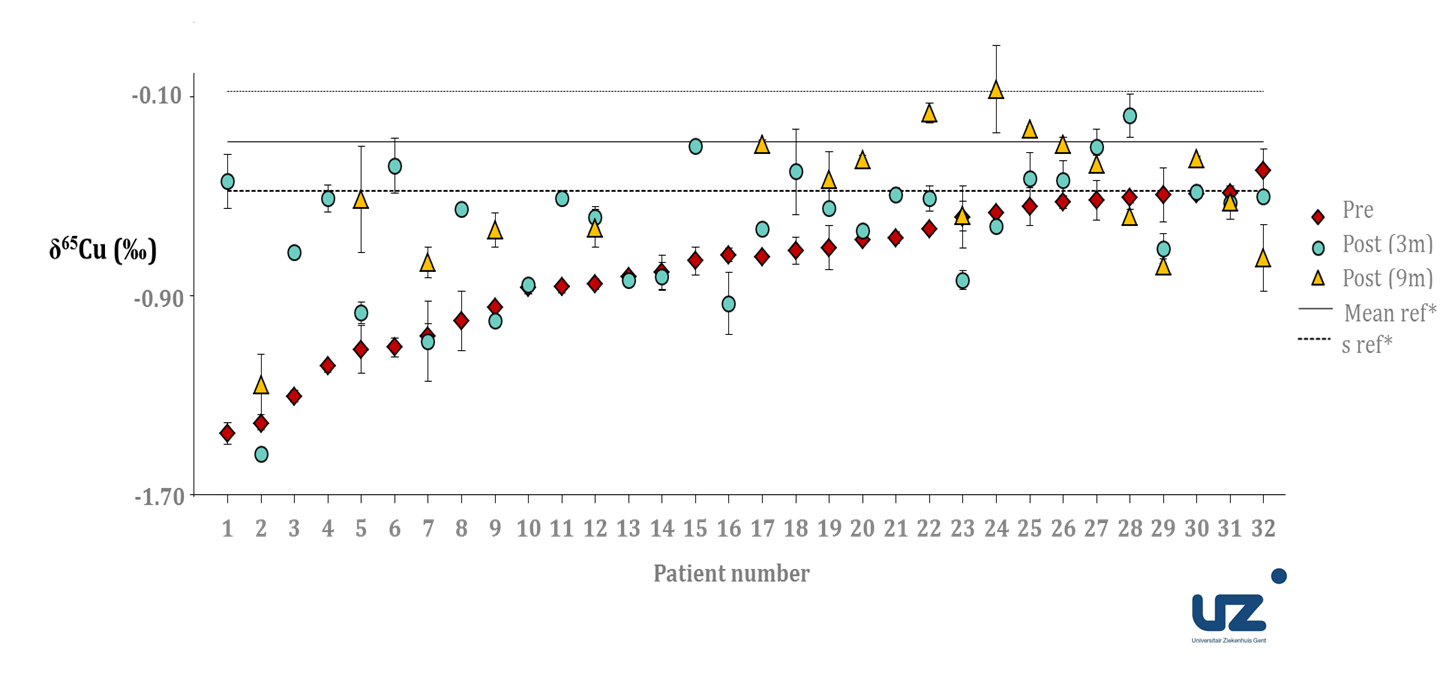
More information: Lauwens et al., Scientific Reports, 2016, 6, Article number: 30683.
-----
Chronic kidney disease (CKD) is a general term for disorders that affect the structure and function of the kidneys. Iron deficiency (ID) and anemia occur in the vast majority of CKD patients, most of whom are elderly. However, establishing the cause of anemia in CKD, and therefore making an informed decision concerning the corresponding therapeutic treatment, is still a challenge. High-precision Fe isotopic analysis of blood serum samples of CKD patients with and without ID/anemia was performed via multi-collector inductively coupled plasma-mass spectrometry (MC-ICP-MS) for such a purpose. Among the CKD patients, the serum Fe isotopic composition was substantially heavier in the occurrence of ID anemia, while erythropoietin-related anemia did not exert this effect. The Fe isotopic composition can thus be useful for distinguishing these different types of anemias in CKD patients, i.e. ID anemia vs. erythropoietin-related anemia.

More information: Anoshkina et al., Metallomics, 2017, 9, 517-524.
------------------------------------------------------------------------------------------------------------------------
Environmental applications
Assessment of Hg Pollution Released from a WWII Submarine Wreck (U-864) by Hg Isotopic Analysis of Sediments and Cancer pagurusTissues
Hg pollution released from the U-864 submarine sunk during WWII and potential introduction of that Hg into the marine food chain have been studied by a combination of quantitative Hg and MeHg determination and Hg isotopic analysis via cold vapor generation multi-collector inductively coupled plasma-mass spectrometry (CVG-MC-ICP-MS) in sediment and Cancer pagurus (brown crab) samples. The sediment pollution could be unequivocally linked with the metallic Hg present in the wreck. Crabs were collected at the wreck location and 4 nautic miles north and south, and their brown and claw meat were analyzed separately. For brown meat, the δ202Hg values of the individuals from the wreck location were shifted toward the isotopic signature of the sediment and, thus, the submarine Hg. Such differences were not found for claw meat. The isotope ratio results suggest direct ingestion of metallic Hg by C. pagurus, but do not offer any proof for any other introduction of the submarine Hg into the marine food chain.

More information: Rua-Ibarz et al., Environmental Science & Technology, 2016, 50,10361–10369.
-----
Lead isotopic analysis of Antarctic snow using multi-collector ICP-mass spectrometry
Reliable determination of Pb isotope ratios in Antarctic snow is challenging because of the low analyte concentration and the low volume of sample typically available. In this work, a combination of a total sample consumption introduction system (the torch-integrated sample introduction system, TISIS) with multi-collector ICP-mass spectrometry (MC-ICP-MS) was used for this purpose. With this instrumental setup, accurate and precise determination of Pb isotope ratios was possible at concentrations as low as 0.5 ng mL-1, while using 0.2 mL of solution only (total amount of Pb: 100 pg). The development and validation, the procedure was applied to concentration range was further extended downwards by using 100-fold analyte element preconcentration via freeze-drying of 20 g of snow. Pb isotope ratios could be determined in snow samples containing ≥5 pg g-1 of Pb. After development and validation, the procedure was applied to snow samples collected at Dome C (East Antarctic Plateau) on a monthly basis during campaigns in 2006 and 2010. The method developed was able to reveal a seasonal variation in the Pb isotope ratios occurring during 2006 and strong inter-annual variation between the two campaigns.

More information: Bazzano et al., Journal of Analytical Atomic Spectrometry, 2015, 30, 1322-1328.
------------------------------------------------------------------------------------------------------------------------
Geo- and cosmochemical applications
Development of an isolation procedure and MC-ICP-MS measurement protocol for the study of stable isotope ratio variations of nickel in meteorites
Variations in the isotopic composition of Ni resulting from natural mass-dependent processes in terrestrial or extraterrestrial conditions, inhomogeneous distribution of nucleosynthetic components and/or ingrowth from radioactive parent nuclides, help us to further understand the early formation history of Solar System materials and the nature of the processes these materials subsequently experienced. In studies of Ni isotope systematics, mass-dependent variations in the isotopic composition of Ni are often bypassed because of the challenges associated with the sample preparation. At the level of natural variation studied, Ni isotope ratio measurements are extremely sensitive to spectral interference, artificial on-column isotope fractionation and possibly even to the mass bias correction model applied. To adequately address these complications, an isolation procedure and measurement protocol relying on multi-collector ICP-mass spectrometry (MC-ICP-MS) have been designed and validated in this work. Nickel isotope ratio variations have been studied in a set of iron meteorites and geological reference materials, and the results obtained, except for those suffering from an elevated 64Zn background, show good agreement with the available literature data.

More information: Chernonozhkin,et al., Journal of Analytical Atomic Spectrometry, 2015, 30, 1518-1530.
-----
Single-step chromatographic isolation of lithium from whole rock carbonate and clay for isotopic analysis with multi-collector ICP-mass spectrometry
Lithium isotope ratios play a key role in tracing weathering processes within the context of paleoclimatologic research. Therefore, accurate and precise determination of the isotopic composition of Li is required for a large variety of complex geological samples with widely different Li contents. We have fine-tuned existing cation exchange chromatographic procedures for their use in the isolation of Li from whole-rock carbonate and clay matrices prior to its isotopic analysis via multi-collector ICP-mass spectrometry. The method developed permits the isolation of ≥20 ng amounts of Li from carbonates and clays. Li recoveries ≥99% were achieved and isotopic analysis using 10–20 ng of isolated Li resulted in accurate and precise δ7Li values. The analytical procedures developed allow Li isotope ratios to be investigated in parallel in both the clay and carbonate fractions of a geological sample within the context of paleoclimatological research.

More information: Van Hoecke et al., Journal of Analytical Atomic Spectrometry, 2015, 30, 1518-1530.
-------------------------------------------------------------------------------------------------------------------------------
Provenance determination
Isotopic analysis of Sb using multi-collector ICP-mass spectrometry for provenance determination of Roman glass
Based on promising results obtained in earlier work on antimony ores, we have investigated the use of natural variation in the isotopic composition of Sb as determined using multi-collector ICP-mass spectrometry (MC-ICP-MS) for provenancing Roman glasses. In antiquity, Sb was used either as a decolourizer or as an opacifier and thus, colourless and opaque coloured glasses from different regions and periods were selected for investigation. Both, the sample digestion and isolation of Sb preceeding isotopic analysis via MC-ICP-MS have been optimized and validated for this type of materials. The 123Sb/121Sb isotope ratio in glass could be determined with a reproducibility (or external precision) of ca. 0.4ε, while in Roman colourless and Hellenistic opaque glass samples, a variation of 3 to 4ε units was found. The results seem to suggest the use of similar Sb sources for both types of glasses, and the existence of at least two different Sb sources for glass production in the Roman era.

More information: Lobo et al., J. Anal. At. Spectrom., 2013, 28, 1213-1219.
-----
Strontium isotopic analysis as an experimental auxiliary technique in forensic identification of human remains
Strontium isotopic analysis has been used in the last three decades to trace the (geological) source of both archaeological and modern organic and inorganic materials. We have reported on the application of Sr isotopic analysis via multi-collector ICP-mass spectrometry to present-day forensic investigations. By determining the 87Sr/86Sr ratio, the geological origin of Sr in human remains such as bone and tooth enamel can be revealed. In this way, an attempt at unravelling the geographical–geological area of residence of the person in question is made, from birth until the last years of his/her life. Although the technique is neither detailed nor exclusive in determining the residence of a person during life, it can provide essential clues in reconstructing the origin or provenance of human remains and in this way, help in the identification of unidentified individuals in a forensic context.

More information: Degryse et al., Anal. Methods, 2012, 4, 2674–2679.
-----
Validation of the determination of the B isotopic composition in Roman glasses with laser ablation multi-collector inductively coupled plasma-mass spectrometry
The applicability of laser ablation multi-collector inductively coupled plasma-mass spectrometry (LA-MC-ICP-MS) for the determination of the B isotopic composition in Roman glasses was investigated. The δ11B values thus obtained provide information on the natron flux used during the glass-making process. The glass samples used for this purpose were previously characterized using pneumatic nebulization (PN) MC-ICP-MS. Unfortunately, this method is time-consuming and labor-intensive and consumes some 100 mg of sample, which is a rather high amount for ancient materials. Therefore, the use of the less invasive and faster LA-MC-ICP-MS approach was explored. The results for 29 Roman glasses and 4 home-made glasses obtained using both techniques were compared to assess the suitability of LA-MC-ICP-MS in this context. The results are in excellent agreement within experimental uncertainty.

More information: Devulder et al., Spectrochimica Acta B, 2015, 105, 116-120.